TACKLing the heterogeneity challenge in dementia using AI
.tmb-cfthumb_s.png?Culture=en&sfvrsn=f994f52d_2)
TACKLing the heterogeneity challenge in dementia using Artificial Intelligence (TACKL-HD-AI)
Using AI to understand variability in causes of dementia and clinical presentations
Alzheimer’s disease and related dementias are becoming more prevalent with the aging of the baby boomer population and are imposing a major challenge to society, both from a financial and social perspective. Individuals suffering from dementia experience memory loss and decline in other mental abilities, which significantly impacts their quality of life.
Research has significantly advanced our understanding of the risk factors for dementia. Comprehensive information, including demographic (age, sex, education), genetic (DNA sequence), cardiovascular (high blood pressure, diabetes, high cholesterol, smoking) and lifestyle (lack of exercise) can help to guide insight and inform on dementia risk. However, many questions remain unanswered, most notably how to disentangle the various trajectories that individual brains will experience to reach a state of dysfunction.
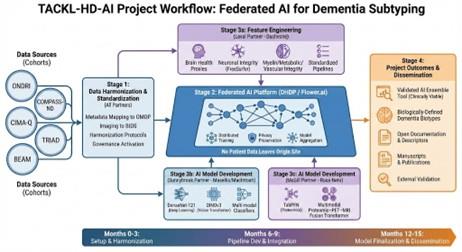
Novel methods of better understanding this complex risk profile and being able to modify it to reduce the occurrence of dementia are urgently needed. The “TACKLing the Heterogeneity challenge in Dementia using Artificial Intelligence (TACKL-HD-AI)” study is a multi-site collaborative research program that will leverage ‘big’ data from several Canadian neurodegenerative disease cohorts (Ontario Neurodegenerative Disease Research Initiative [ONDRI], Comprehensive Assessment of Neurodegeneration and Dementia [COMPASS-ND], Sunnybrook Dementia Study [SDS], the Brain Eye Amyloid Memory [BEAM] study, Translational Biomarkers of Aging and Dementia [TRIAD], and the Quebec Consortium for the Early Identification of Alzheimer’s Disease [CIMA-Q]) to disentangle the complexity underlying dementia risk.
Analyses using Artificial Intelligence will examine how an individual’s genetic, demographic and cardiovascular background, together with neuroimaging, cognitive, behavioural and motor features of the disease may interact to worsen dementia presentation and/or increase dementia risk. Using these personalized/precision medicine approaches, we hope to be able to improve upon the management and prevention of dementia in the future, thus reducing its impact on Canadians.
“Dementia is complex in nature and new treatments are desperately needed. In order to have successful therapies, more understanding is needed regarding how risk factors lead to neurodegenerative diseases that cause dementia. This funding affords the opportunity to understand these underlying mechanisms paving the way towards the goal of precision medicine in dementia”
Project Images